
Freezing F1 History: Exploring the Visceral Dioramas of Alessandro Locatelli
Today we’re going behind the scenes with an artist who creates physical snapshots of some of the most heart-stopping moments of F1 history. Alessandro Locatelli creates highly detailed scale dioramas of dramatic F1 racing incidents, capturing the speed, atmosphere, and drama with breathtaking accuracy and meticulous craftsmanship. Alessandro’s creations are not merely models – they are emotional recreations of moments in history.
HOBBIES & TOYSDIORAMAS
TorqArt
1/11/20267 min read
Torqart: You have a very special and niche hobby. Can you tell us about your background, and what prompted you to start creating such visceral recreations of F1's most dramatic moments?
AL: My passion for scale modeling was born alongside my love for Formula 1 when I was still a child. Together with my father and my sister, I began collecting die-cast models of the most iconic single-seaters in F1 history. As I grew older, however, I realized that simply owning scale models was no longer enough, I felt the need to create something with my own hands.
I built my first Formula 1 scale model kit, followed by many others, and over time my skills and attention to detail steadily evolved but something was still missing: the models were accurate, but they lacked emotion.
That realization marked a turning point. I knew it was time to challenge myself and create something truly personal something unique.
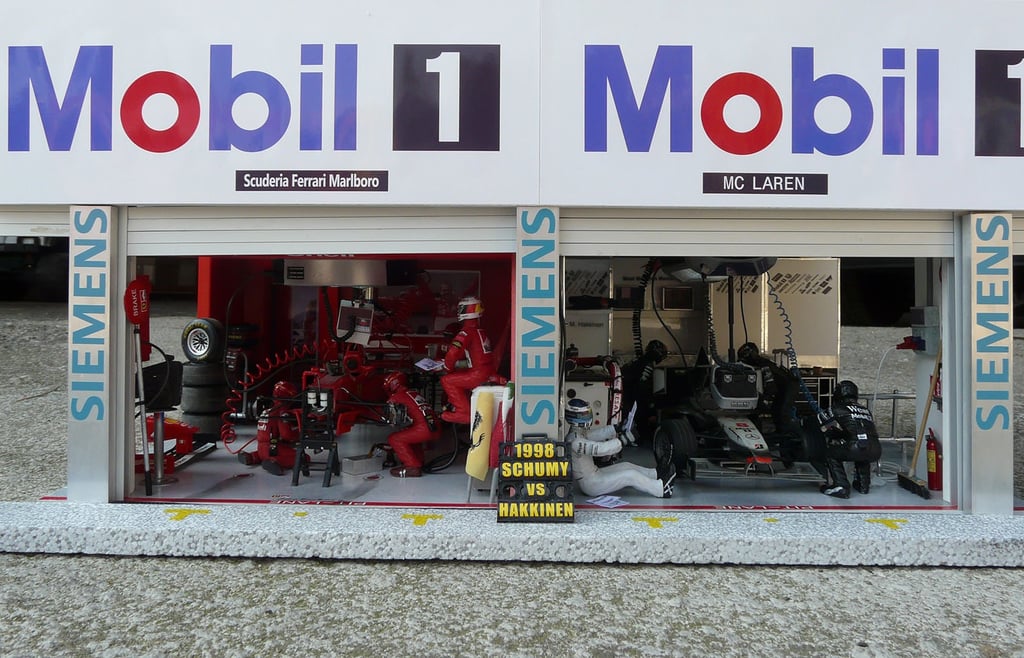
This is how my journey into diorama building began. I started recreating iconic and unforgettable moments from my favorite sport, beginning with a Formula 1 pit box from the legendary Schumacher–Häkkinen era. Many more would follow.
From that moment on, every race watched, every emotion felt in front of the television, became inspiration - each one giving birth to a new idea for the next diorama.
Torqart: When planning a new project, what makes a scene "worthy" of being immortalised in a diorama?
AL: Some moments in Formula 1 leave a lasting mark. These are emotions that have stayed with me over time, and that I aim to reproduce and convey through my dioramas.
Torqart: Is there a particular era, team, driver, or type of incident that inspires you the most, and is there anything that you won’t do?
AL: As an Italian and a 42-year-old, Schumacher and Ferrari marked some of the most significant moments of my adolescence. However, I place no limits on era, team, or driver. Over the years I have created dioramas set in 1978, 1998, 2016, and 2020, featuring different teams and drivers.
Pit Garages, 1998: Schumacher - Häkkinen
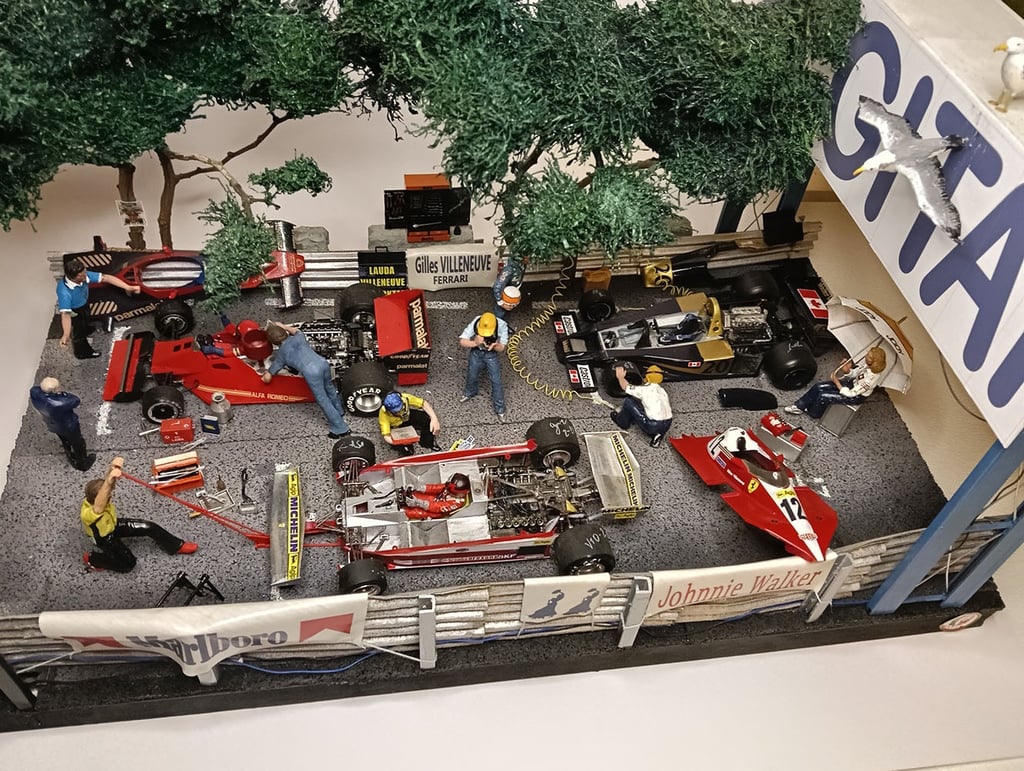
The starting grid, Monaco, 1978: Lauda – Scheckter - Villeneuve
AL: In many cases, crashes tell the story more effectively - complex and intense moments that best convey the tension and meaning of a race. I do believe, however, that there are limits that should not be crossed: tragic events should remain part of collective memory, out of respect for the driver and their family.
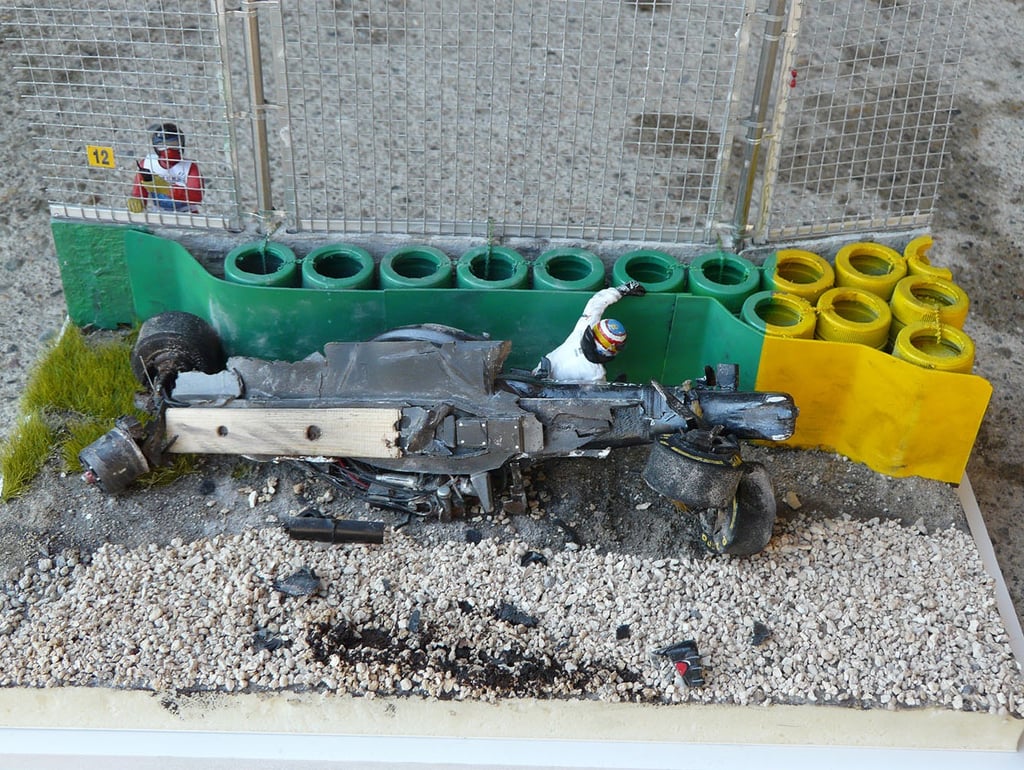
Alonso emerging from the cockpit after his spectacular crash, Melbourne, 2016
Torqart: Could you walk us through your creative process when starting a new project?
AL: The first step, after selecting the moment to be reproduced, is an in-depth study of videos and photographs, in order to gather every detail and identify the exact instant in which each element of the diorama contributes to telling the story.
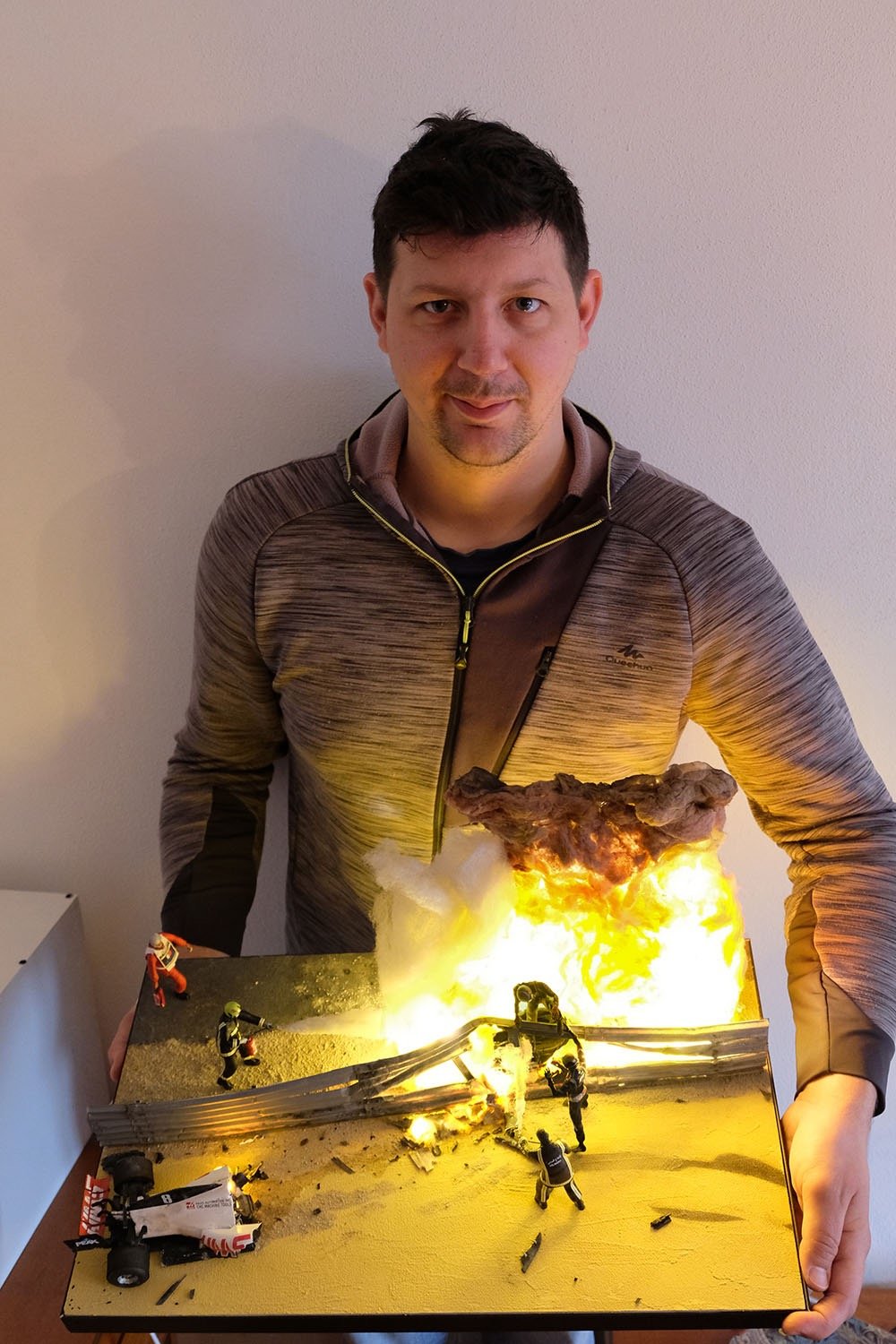
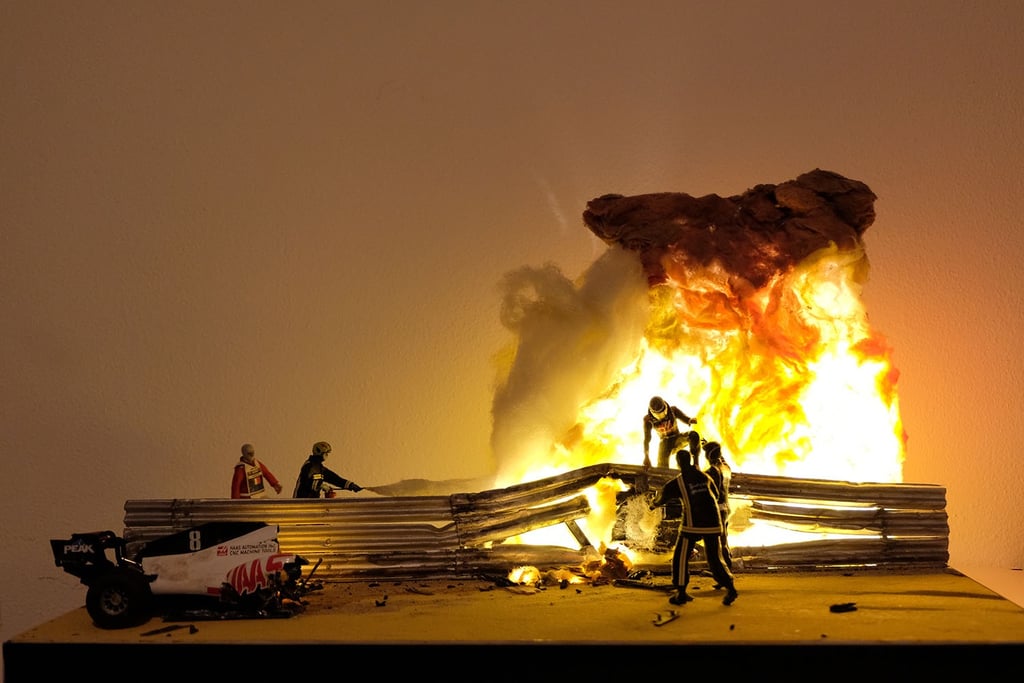
In the diorama dedicated to Grosjean (Bahrain, 2020), I identified the key moment as the instant when the driver emerges from the flames and the doctor is about to reach him. That was the moment when, watching from home, we all began to breathe again and to hope.
Torqart: Do you use the same scale for all or your dioramas or do they vary?
AL: I usually work in 1/20 scale because, within a diorama, it allows me to reproduce not only the event itself but also everything surrounding it, capturing the full context and details of the scene.
Torqart: What are some of the key techniques and/or special tools that you use to create your dioramas?
AL: The key technique in my dioramas is the recreation of every detail in the scene: from the angle of a broken wing to a bent guardrail, from disturbed soil to the smallest, less visible elements. In the diorama dedicated to Grosjean, I fully reconstructed the car’s cockpit, even though only a small part of it is visible. As for tools, I don’t use anything particularly different from other modelers, but I make extensive use of recycled materials—ballpoint pens, PVC pieces, and metal scraps—which I shape entirely by hand. Where others see scrap, I see the potential for a piece that will bring my diorama to life.
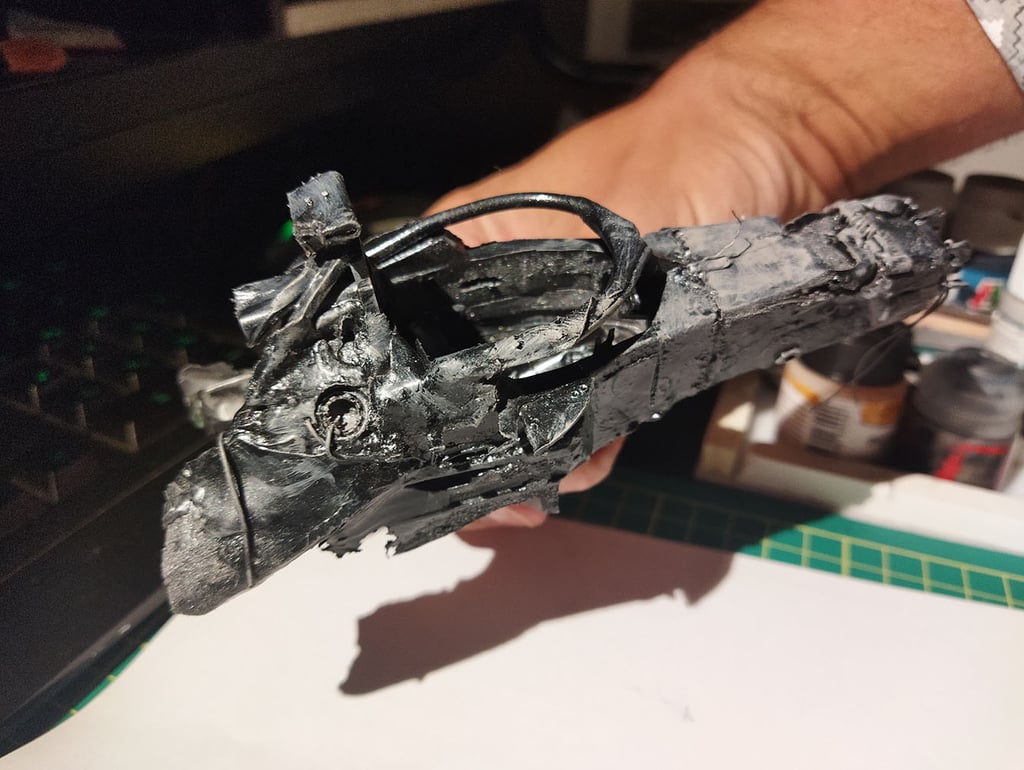
Grosjean’s fiery crash, Bahrain, 2020: Burnt remains of the tub and cockpit
Torqart: Do you generally decide which materials you will use before you start, or do you experiment whilst building to see what achieves the best results?
AL: I like to experiment a lot while building my dioramas. I usually start with a general plan in mind, but I often adapt it on the fly if it doesn’t give me the effect I’m looking for.
Torqart: What is the most “unconventional” material that you have used to achieve a special effect or outcome?
AL: Surprisingly, something as simple as cardboard, water, and Loctite became the key to bringing a detail to life.
In the Grosjean diorama, creating the guardrail was particularly challenging due to the deformation from the impact and fire. After many tests, I decided to wet the corrugated cardboard only in specific areas. This allowed me to shape it without breaking it, and once dry, I treated it with Loctite to harden it, achieving a metal-like effect.
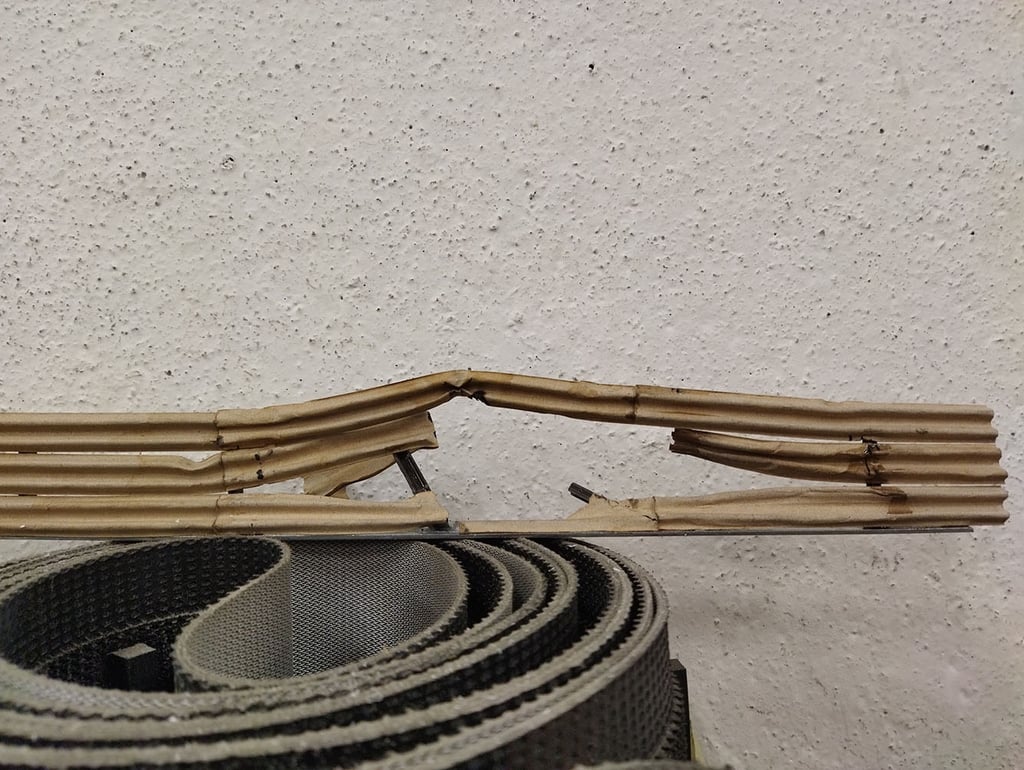
Grosjean’s fiery crash, Bahrain, 2020: Creating the damaged guardrail
Torqart: Tell us how you created the realistic looking “fire” in the Romain Grosjean crash diorama?
AL: After studying the frame of the flames, I sketched the guidelines for the electrical system on the base of the diorama, shaped the polyurethane, and installed the two bulbs and a LED strip.
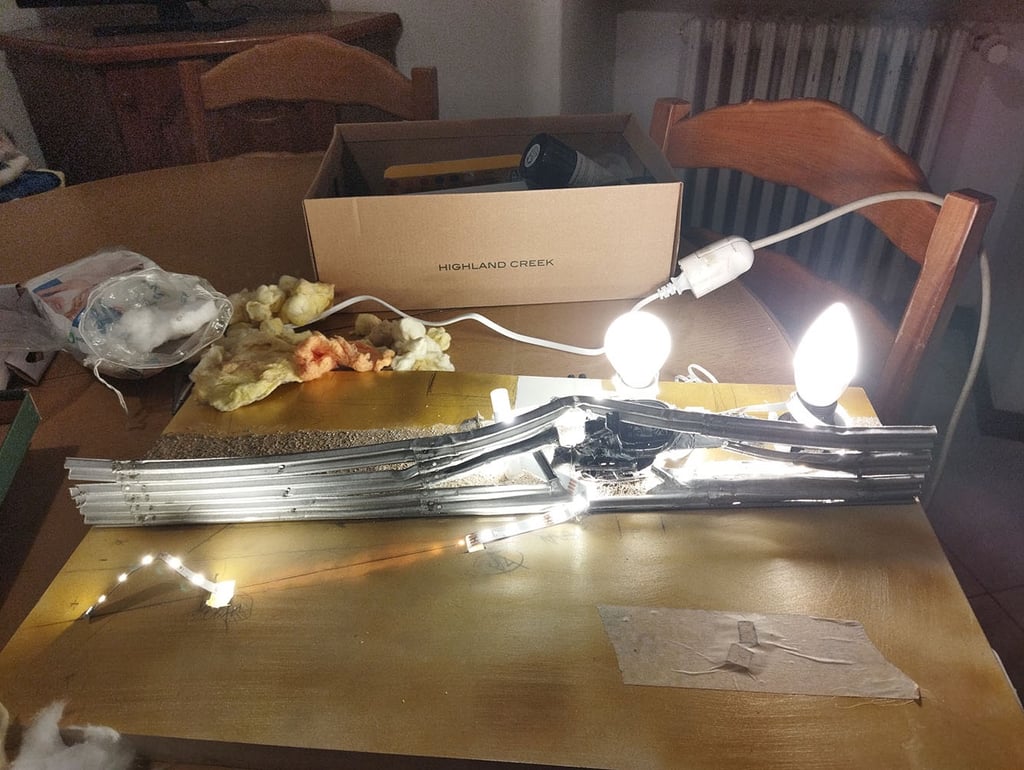
Grosjean’s fiery crash, Bahrain, 2020: Creating the glow effect for the fire
AL: I then built a hexagonal metal mesh around them, which holds the desired shape, and once the structure was set, I applied cotton that had been dyed in a mixture of yellow, orange, red, and black.
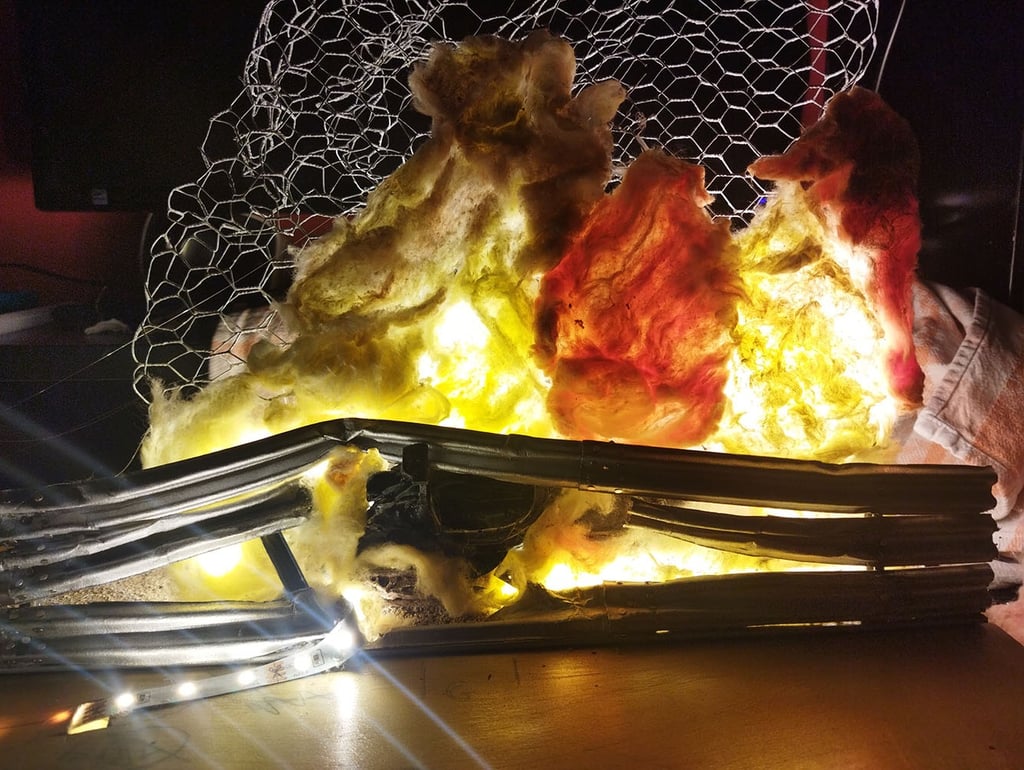
Grosjean’s fiery crash, Bahrain, 2020: Building the mesh to support the cotton for the fire and smoke effect
AL: To recreate the swirl and the dust cloud from the fire extinguishers, I used industrial filter sponge and instant glue.
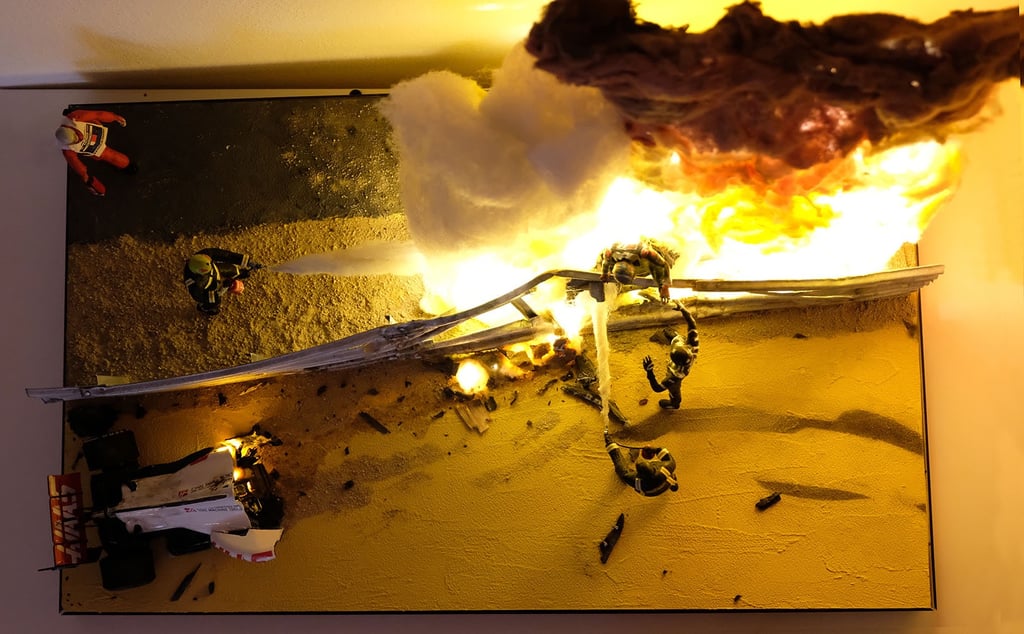
Grosjean’s fiery crash, Bahrain, 2020: Sponge and glue was used to create the foam spray from the fire extinguishers
Torqart: I can imagine capturing a sense of speed in a static model can be quite challenging. Does lighting also play an important role in conveying the atmosphere or “mood” of the scene?
AL: Lighting in a diorama can be a double-edged sword. On one hand, when done well, it enhances the scene and adds extra impact. On the other hand, the entire diorama must be designed around the light, as it affects every color and detail applied.
Torqart: Can you tell us about your favourite diorama and what made it special or challenging?
AL: I won’t deny that the Grosjean diorama is one of my most significant works, but I believe the one depicting Schumacher and Coulthard in the rain at Spa has something extra. Perhaps it’s because, coming after the fire diorama, I was afraid I wouldn’t be able to challenge myself again. In modeling, water and fire are almost taboo due to their complexity, and I didn’t have many examples to draw inspiration from. Creating that scene was also exciting because it captures a moment that still evokes strong emotions for those who experienced it.
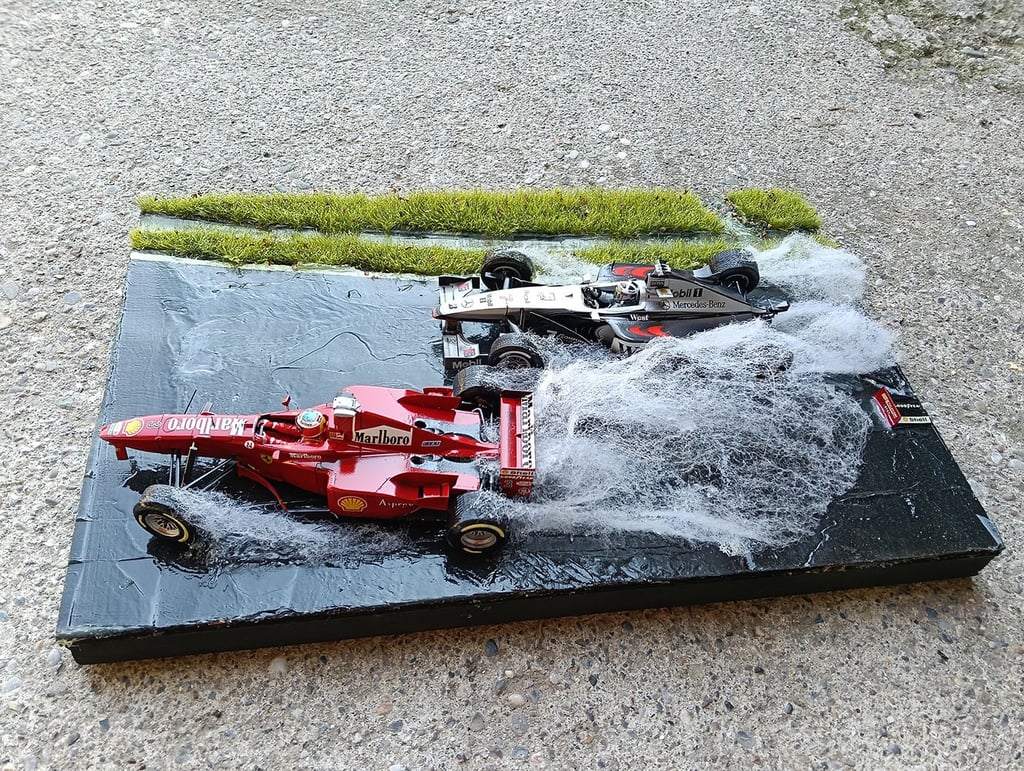
Collision in the rain, Spa, 1998: Schumacher vs Coulthard
Torqart: Do you belong to any model-making groups, and is the diorama/model-making community helpful in sharing ideas and techniques with other artists?
AL: I am a member of A.M.P. (Associazione Modellisti Pumenenghesi), a collective of modelers from various fields, but above all, a group of friends with whom I share ideas, techniques, and the experience of exhibiting at modeling shows across Italy.
Torqart: What advice would you give to someone who wishes to begin creating dioramas?
AL: Never look at a diorama as a single object; instead, consider how each element can help tell the story you want to convey.
Torqart: Do you have ambitions to turn your hobby into a career, perhaps creating unique motorsport dioramas for paying customers?
AL: It would be a dream to turn my passion into a career, but for now, I feel incredibly lucky to see my creations around my home and to watch them bring joy and admiration whenever I exhibit them at shows.
Torqart: Are you planning any new dioramas that you can share with us …and is there anything that you haven’t done that you would like to do?
AL: I’m already working on three new dioramas, but they are still in the early stages, and I don’t want to reveal anything until they’re finished. As I mentioned before, my ideas often evolve during the creative process, so I’ll leave you with a bit of suspense.
Torqart: We’ll look forward to seeing them!
A huge thank you to Alessandro for taking us inside his workshop today. If you want to see more of these incredible dioramas, be sure to follow Alessandro’s journey at -
Alessandro with his Diorama of Grosjean’s fiery crash, Bahrain, 2020

