
Harmony in Contrasts: Balancing the Intersection of Line and Form with Stephen Selzler
In the world of automotive art, there is a fine line between technical illustration and soulful expression. Few walk that line as gracefully as Stephen Selzler. Known for his overlapping draftsman lines, masterful use of light, and an uncanny ability to capture the personality of a car, Stephen has become a standout voice in the modern automotive art scene. In this exclusive interview, Stephen opens up about his artistic journey, his inspirations, the influence of historical art movements, and the specific techniques that define his signature style.
FINE ARTFEATURED
TorqArt
2/11/20269 min read
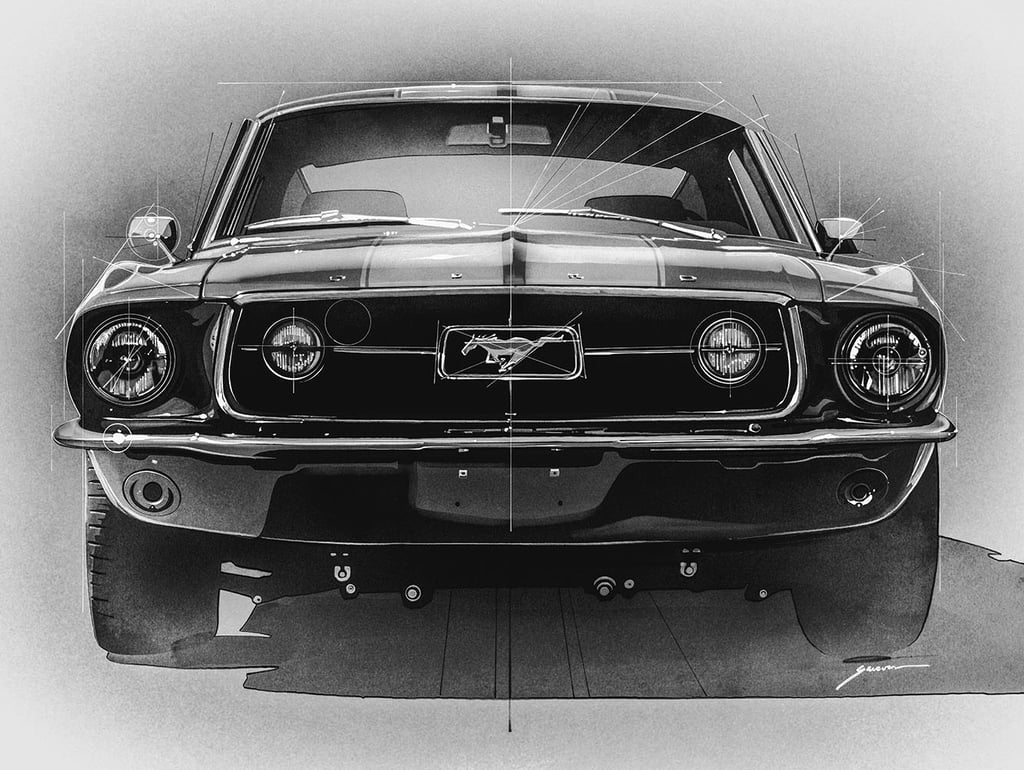
'69 FORD MUSTANG © STEPHEN SELZLER
Torqart: Can you tell us what inspired your journey into automotive art?
SS: I've been drawn to art since I was a little kid, picking up pens, crayons, and paints was second nature. Growing up in an artistic household with parents who were creative in their own ways made it feel like a natural environment, almost a self-fulfilling prophecy.
I loved cars from the beginning, and growing up around them, drawing, tracing, and studying them obsessively. I explored other art forms too, and in college I studied graphic design and marketing, enjoying the commercial, digitized side of art. Still, that little boy inside kept pulling me back to cars. Eventually, I pursued a path that led to running a self-sufficient studio focused primarily on automotive art.
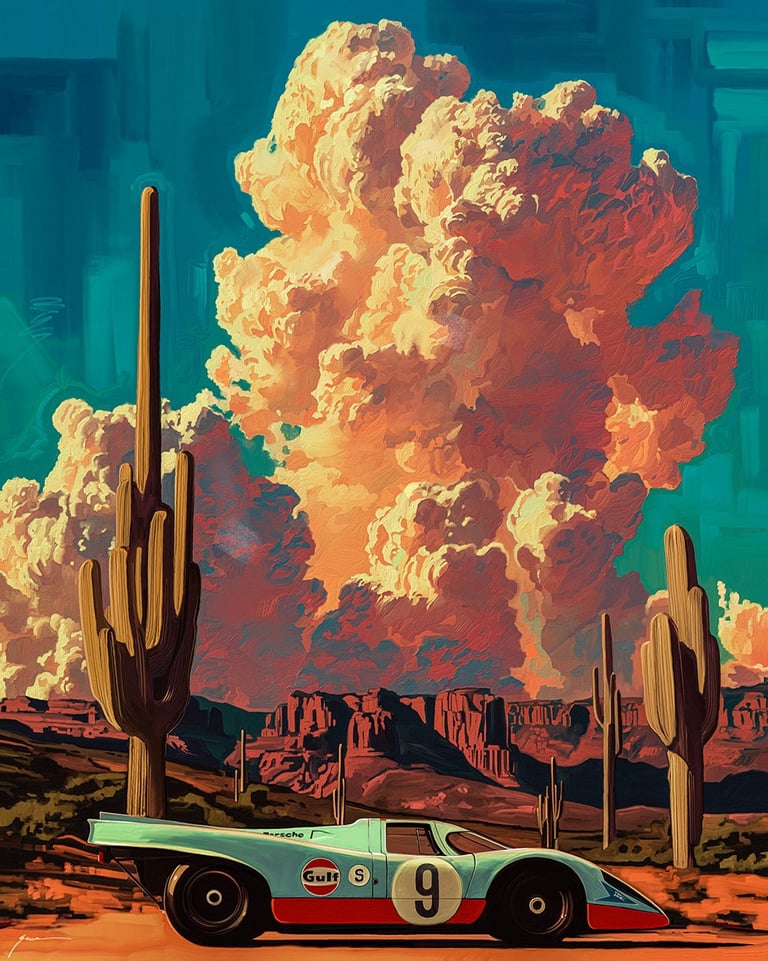
DESERT PORSCHE 917 © STEPHEN SELZLER
Torqart: Which era of car design do you find most visually stimulating, and how does its specific design language influence your approach to a new piece?
SS: It used to be the 1980s and '90s cars I grew up with, which draws a lot of the same visual cues and proportions from the golden age of automobile design - after WWII through to the 1960s. You can look at any type of automobile from that era and see the direction that they were heading in, based on things that were objectively beautiful, especially things that are beautiful in nature. If you talk to anyone within the automotive design field, they really wish that we could get back to an era where things were very much about visual identity and proportions that you find in nature. Think of a 1960s Jaguar, poised like a cat on its haunches, ready to pounce. There's a proportional aesthetic that the 1960s just had a way of nailing, and that's the era that truly captivates me.
Because a piece tends to be on a canvas that is square or rectangular in nature, it already has a brutalist attitude in the substrate that you are painting on, and I am the kind of guy who is attracted to contrasts, so I counter that with voluptuous, organic curves and rich forms. I celebrate those natural elements, using straight lines to ground the organic shapes. My pieces often feature stationary cars, but through overlapping draftsman lines, flow, and balanced man-made/organic elements, they convey assumed movement and emotional character.
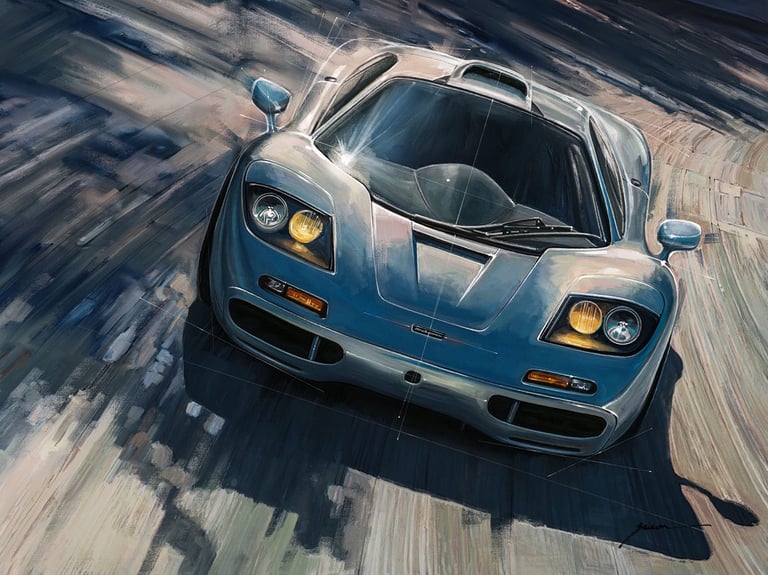
MCLAREN F1 © STEPHEN SELZLER
Torqart: Beyond the automotive world, which artists or movements (e.g., Bauhaus, Mid-Century Modernism) have most heavily influenced your aesthetic?
SS: Mid-Century Modern influences my aesthetic because it ties into the 1950s, 1960s, maybe early 70s cues. It has a lot of those same visual cues that you will see in advertising, furniture, buildings etc., with pleasing and balanced proportions. It follows a golden ratio with elements that try to emulate nature. It's not always obvious in my work, but I draw from it subtly.
Bauhaus influences me too, simple without being simplistic. It wasn't too elementary and had a playful character along with a very simplified tone and reasoning to exactly why, where, how things are placed. I try to create that homeostasis between something that is celebratory of the man-made, like the rich and rugged structural elements of a vehicle - balancing between the man-made and the organic. My attention starts to run out when we get into post-modernism, which tends to break down a lot of those narratives.
Torqart: Could you walk us through the evolution of a new piece?
SS: Unfortunately, some vehicles don't photograph well but shine in person, so I start by spending physical time with the car if possible. If I don’t have access to the vehicle, I gather reference collages mimicking a 24mm focal length for natural, human-eye proportions, so the shape feels like it's more correct. A lot of my work ends up being a reflection study, focusing on highlights, reflections, and high-gloss paint. I love doing things that render reflections attractively - those "candy" effects are so rewarding.
A lot of times I sketch digitally first, testing concepts, colors, different brush strokes, and washes – always checking to ensure that I’m not overcooking my ideas.
Once I’m satisfied with the digital rendering, I’ll go through the same process with paint, doing an underpainting, color blocking, adding mid-tones to shape the vehicle and separate it from the background – basically a layered effect. When I’m happy that the painting is as tight as I want it to be, I’ll add white specks for sunspots, which are the high-reflection points evoking heat and light. Finally, I add back my rendering lines (which is a small cue to my signature style), I’ll sign the piece, and stop, with minimal touch-ups after that. It's a completed recipe, and ready to be enjoyed.
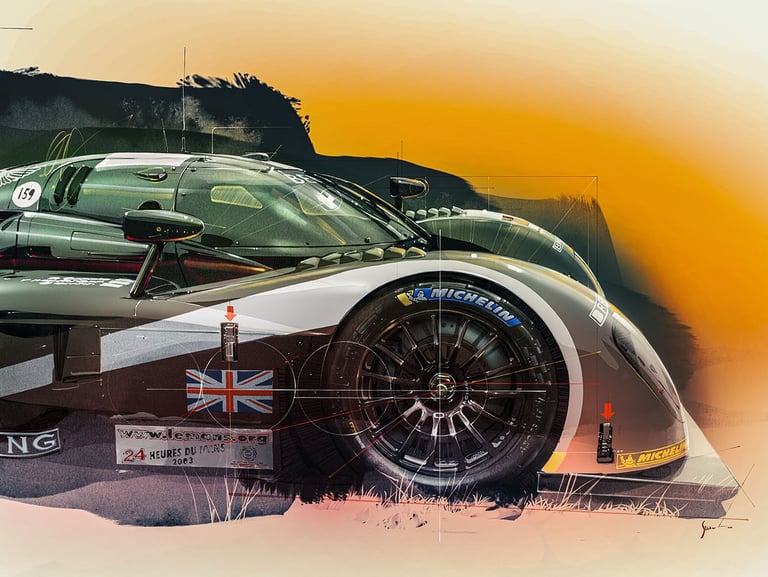
BENTLEY SPEED 8 © STEPHEN SELZLER
Torqart: Your compositions are a masterclass in balance. How do you decide how much technical information to include versus how much emotion (abstraction or atmosphere) to let take over?
SS: It's largely gut feeling with no strict formula, though recently I've found success in creating renderings of cars from a child's perspective, with exaggerated scale, towering presence, with your eyeline being pretty much at the beltline, making the car appear bigger - although I don't want to over-exaggerate the car to the point where it turns into something cartoonish. As far as other elements of the composition, I think it’s important to include visual references (people, a building, a tree etc.) but the car remains the star.
I rely on tried-and-true principles like the rule of thirds, leaving you with some breathing room and balance, creating intentional neutral space, because sometimes compositions can be overwhelming. It's intuitive, learned through osmosis from my environment rather than rigid measurement - I just know what feels right and run with it.
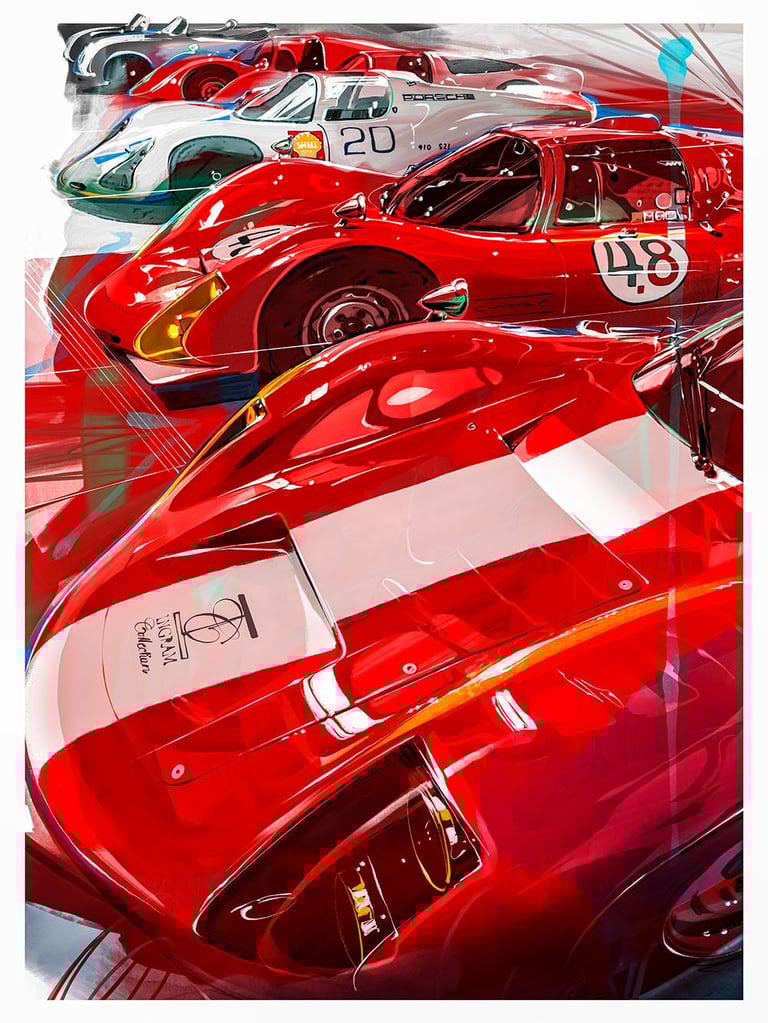
PORSCHE GROUP © STEPHEN SELZLER
Torqart: When working on a private commission, how do you weave the car’s specific provenance or the owner's personal story into the composition without it feeling like a literal "portrait" of a vehicle?
SS: Many owners want a portrait, but I try to make it more interesting by asking about their experiences with the car, getting some background story and emotions. Sometimes I will weave in details like the VIN number, children's birthdays, or acquisition date as subtle Easter eggs - inconspicuous notations, sketch-like marks, or text that reveal personal meaning, and as you get closer to the canvas, especially if it's a nice large piece, you start to see these little cues everywhere. I ask if they want the car in an environment that evokes a memory, for example a racetrack, a garage, the day that they acquired it etc. The environment can be just as important as the car.
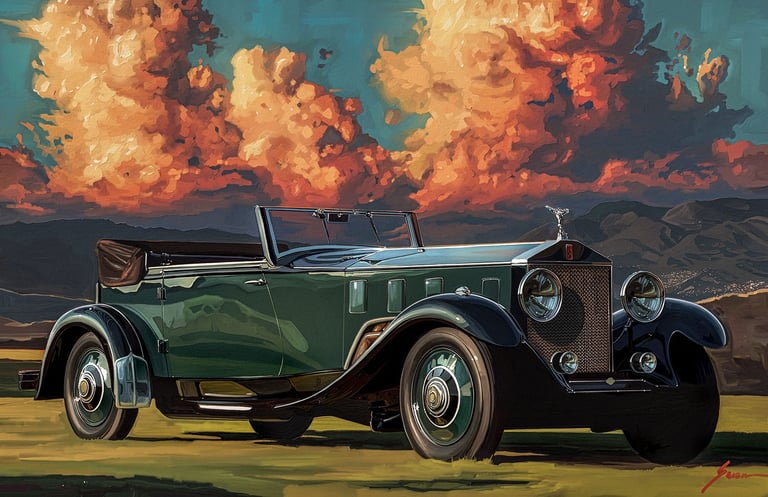
1931 ROLLS ROYCE PHANTOM II MERLIN SPECIAL © STEPHEN SELZLER
Torqart: Does your choice of medium (oil, acrylic, etc.) change how you approach the car you are painting?
SS: It often depends on the timeline. Generally, I prefer starting with acrylics because I like to work quickly, avoiding oil's as they’re too slow to dry. If a piece needs an extra level of color fidelity or depth, I'll layer oils over acrylic bases. I lean toward mixed media overall - acrylics, pen and ink, spray paint for embellishment, colored pencil, oil pastel, Conté crayon. Cars are generally very smooth and sleek, so by adding some textural, rougher medias, for instance capturing the illusion of high-gloss paint, I can balance between yin and yang.
Torqart: Can you tell us about one of your favorite pieces and what made it special?
SS: I did a commission for Aston Martin of Dallas. This piece was a front-on DB5 (James Bond car) in silver-green tones, a massive 12 feet long by 9 feet tall. I was initially lukewarm on whether I really liked it but once installed and under studio lights at the dealership, its presence was unforgettable. For the underpainting I mixed different paints together and let them drip down, letting gravity feed it all the way to the bottom, and then rendering the car on top as if it's jumping out of the scene. My use of a palette knife, oil pastels, and embellishments gave it so much to look at and discover within. It's a visual playground.
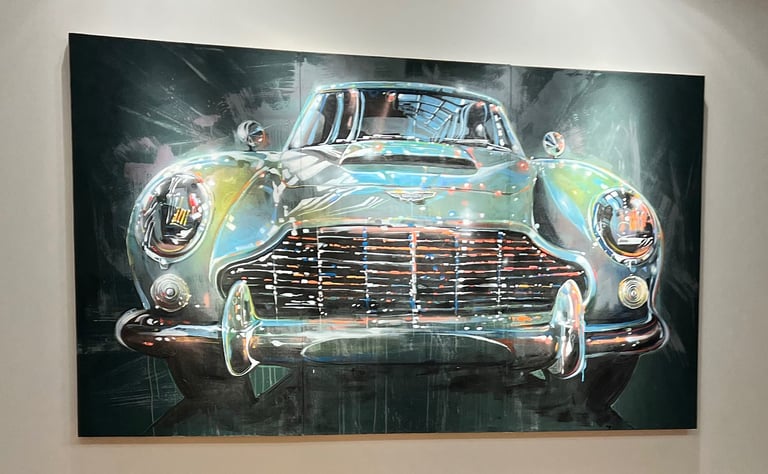
ASTON MARTIN DB5 © STEPHEN SELZLER
Torqart: In an era of digital saturation, how vital has networking and relationship-building with collectors and brand stakeholders been to your success?
SS: They're vital to my success, and if we look at economies in general, people often do prefer to buy from other people and not just nameless and faceless corporations, which is why corporations will hire people to be the front-facing diplomat and representative of the brand.
I connect with automotive art friends, sharing tricks, propping each other up, despite some competitiveness. Clients vary, with some preferring old-school communication, whilst others live on socials. I adapt to both, using digital tools to stay visible, and embracing technology for relationship management.
Torqart: For the next generation of automotive artists, what is the most important piece of advice you can give, in regard finding their "voice" in a crowded market?
SS: In the beginning, find your favorite artists (automotive or otherwise) and copy their work relentlessly to build your skills through repetition, and don’t just focus on one, find a variety of artists. My voice came from blending car drawing with architectural rendering influences. Test, refine, show it widely (even to skeptics) for feedback. Maximize what works, repeat, curate. There are no short cuts, but over time, something uniquely yours will emerge.
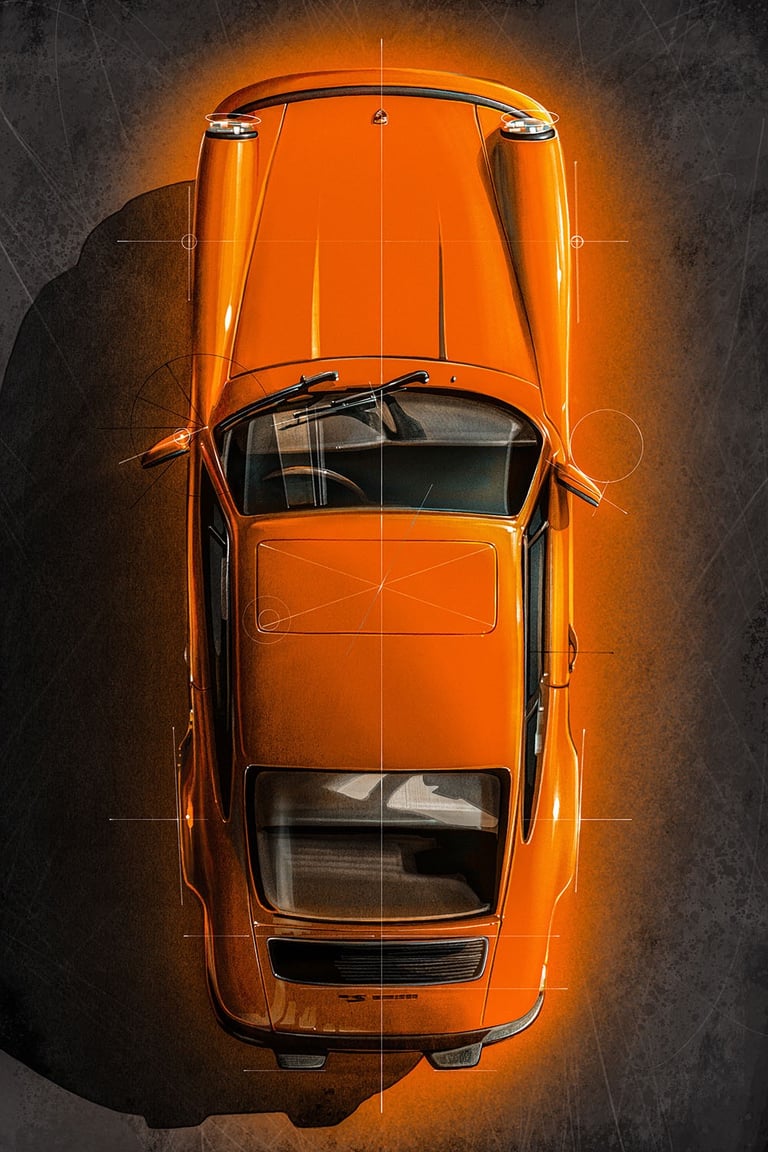
PORSCHE 911 © STEPHEN SELZLER
Torqart: With the rise of AI-generated imagery, is there a specific "human element" that you strive to keep in your work that AI simply cannot replicate?
SS: It’s interesting because AI is getting closer to mimicking human inexactness, but the true human touch, an indefinable X-factor remains un-replicable. Machines don’t have a story, they are an algorithm with instantaneous output, whilst humans bring organic chaos and soul.
Torqart: Do you believe the "glut" of digital art will potentially lead to a higher premium and appreciation for physical, hand-painted works?
SS: Yes. The oversaturation of easily replicated digital images cheapens them, much like mass-produced items versus originals. Physical works demand human labor, the stretching of a canvas, sourcing materials, time, coffee-fueled revisions, emotional risk.
I think humanity will always prefer to put a premium on something that is produced organically and naturally. The best defense is documenting the process relentlessly - the stories and proof of human labor to show authenticity. Documenting the story, process, verification, and authenticity builds deeper value, like a car's provenance binder at concours.
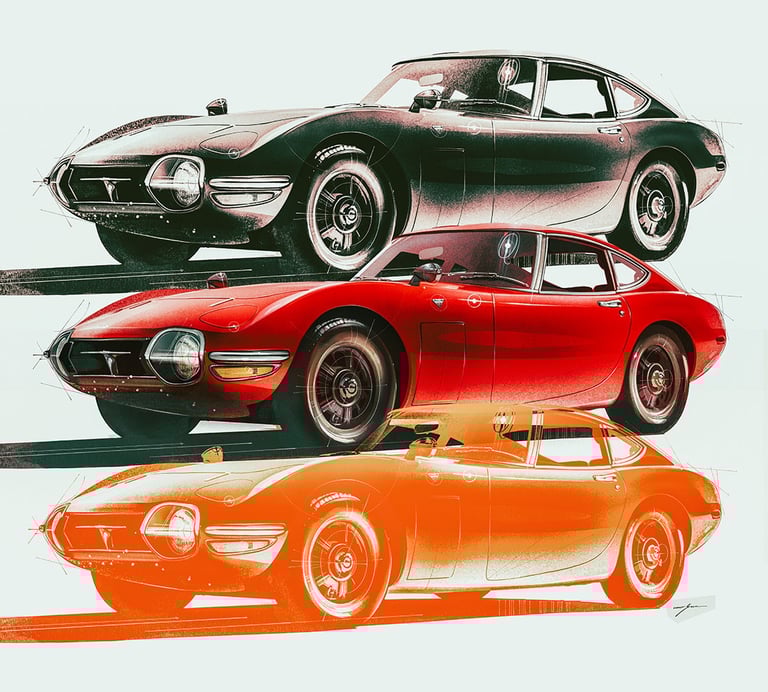
TOYOTA 2000GT STACK © STEPHEN SELZLER
Torqart: If you were tasked with capturing the "most beautiful car in history" to represent your legacy, which car would be on the canvas and why?
SS: The 1950s Ferrari 250 Testa Rossa open-top racing car (similar to the Jaguar D-Type era). It's a masterclass in organic proportions and golden ratio balance. It is a shapely, nature-inspired beauty. That vivid red, long hood/short rear proportions, teardrop headrest fin, blanked passenger side - it looks fast standing still, it cuts air like a speedboat, poised like a jungle cat ready to pounce. I love drawing this car, and it looks great with minimal livery, it’s gorgeous. It’s so iconic that you could recognize the car by the shape of its shadow alone. There’s nothing else like it!
Torqart: Great choice – the 250 TR is also at the top of my all-time favorites list!
Torqart: What has been the most rewarding moment of your career so far, and is there a "dream project" you have yet to tackle?
SS: There was a moment when Bentley invited me to help spec three special cars from the Mulliner program, which was the first time a manufacturer put their trust in me for creative direction on physical products, collaborating closely with their UK headquarters. It felt like recognition of my brain space, circling back to my childhood dream of automotive design.
The opportunities that came from that project were tremendous. I got to work with Bentley, Painting live at Pebble Beach in 2025 for VIP guests, as well as their design team, and leadership from America and their global headquarters. It was incredible - all eyes were on my vision of being able to celebrate Bentley heritage and the Bentley name. I'll chase that feeling forever.
As for my dream project, I would love to design and build my own car to sit on the lawn at Pebble Beach. A friend (ex-sculptor turned Porsche restorer) inspired me to take my vision and artistry from a painting to a tangible object. I would love to create something so awesome people want to paint it someday. I'd extend that to other objects, but cars are closest to my heart.
Torqart: It would be wonderful to see this project reach fruition and I wish you the best of luck in making it a reality!
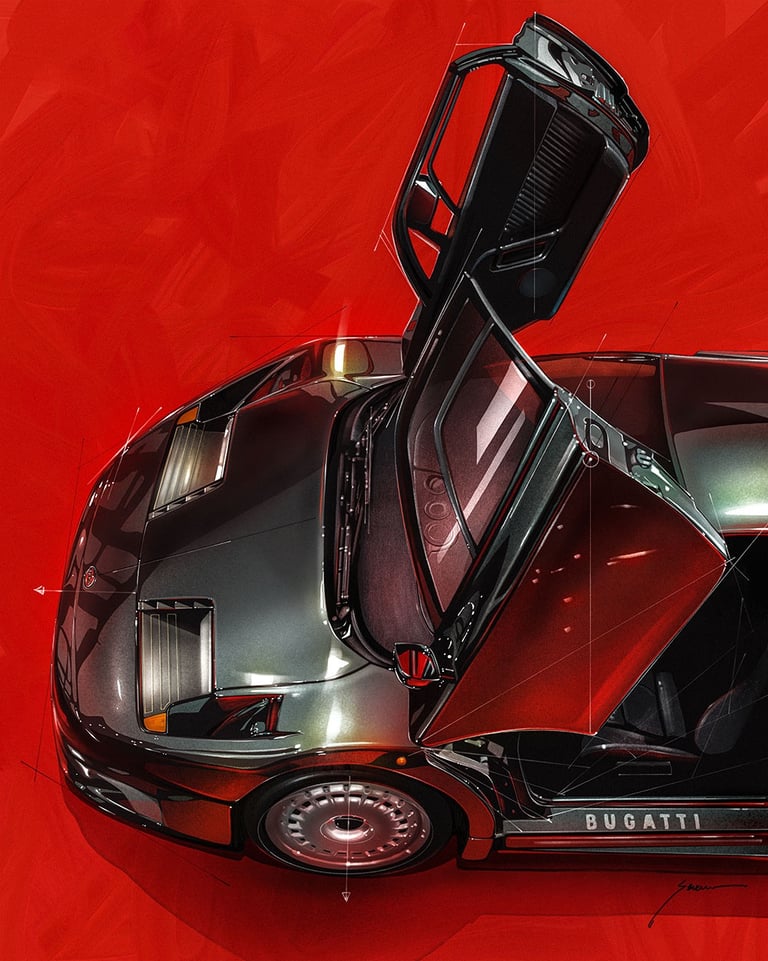
BUGATTI EB110 SS © STEPHEN SELZLER
Torqart: A huge thank you to Stephen for sharing his story, insights, and creative process with us.
Check out more of Stephen’s work at his website: https://stephenselzler.com/

