
Soul in the Machine: Reviving the Golden Age of Art Deco with Geoff Ombao
As an Associate Professor at ArtCenter College of Design, Geoff Ombao divides his time between the analytical world of Human Factors and Design Psychology and the evocative 'Golden Age' of automotive aesthetics. As a prolific digital artist, Geoff’s work is a masterclass in the interplay of bold lines, shadows, and sweeping, romantic curves - perfectly capturing the noir-inspired mood of 1930s Art Deco. Today, we sit down with Geoff to discuss his evolution from student to mentor, and the spirit of the “Streamline Moderne" design language.
DIGITAL ART
TorqArt
2/23/20268 min read
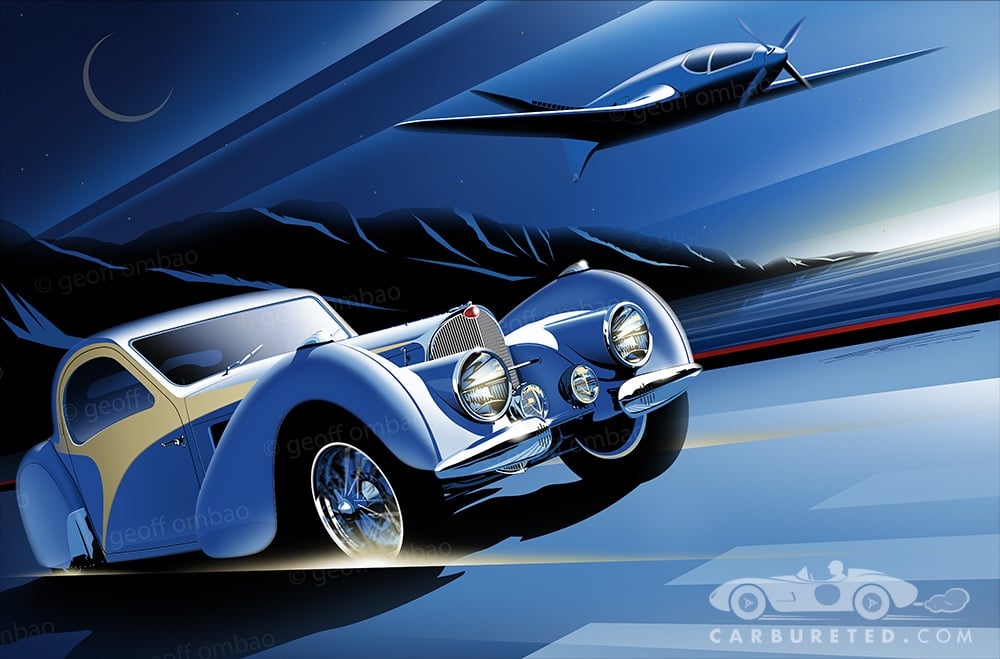
BUGATTI ATLANTIC © GEOFF OMBAO
Torqart: Can you tell us about your earliest interest in automotive design, your journey to get to where you are today, and any defining moments along the way?
GO: I’ve been passionate about cars since childhood. I have an early memory from the 70’s of a car ride with my dad and brother; my dad pointed out different Cadillacs as they passed and told us how we could identify their model years by their taillight designs. I was fascinated (and addicted). Years later, a guy who lived on my street bought a Delorean… every time he drove by, my world stopped so I could drink in that other-worldly design. In my teens, I fantasized about studying car design, and learned about ArtCenter’s transportation design program, but I had no art/design training. I
decided to go to Drexel University to study design and merchandising for a couple of years before applying. I eventually submitted my portfolio… and was rejected. I concluded that a design discipline with broader career opportunities would be a more logical direction. So I ended up at School of Visual Arts (SVA) in New York to study graphic design.
After working in graphics for a few years, I heard about an emerging field called “interactive media”. Intrigued, I returned to SVA for my Masters Degree, and went on to have some great experiences with Time Warner, The Walt Disney Company, Pioneer Electronics, and others. Though I was fortunate to work on some cutting-edge projects, the car design passion was always burning in the background. When I hit my mid-40’s I felt like I really needed to “scratch the itch”. So I applied to ArtCenter, and was eventually accepted into their Transportation Design program.
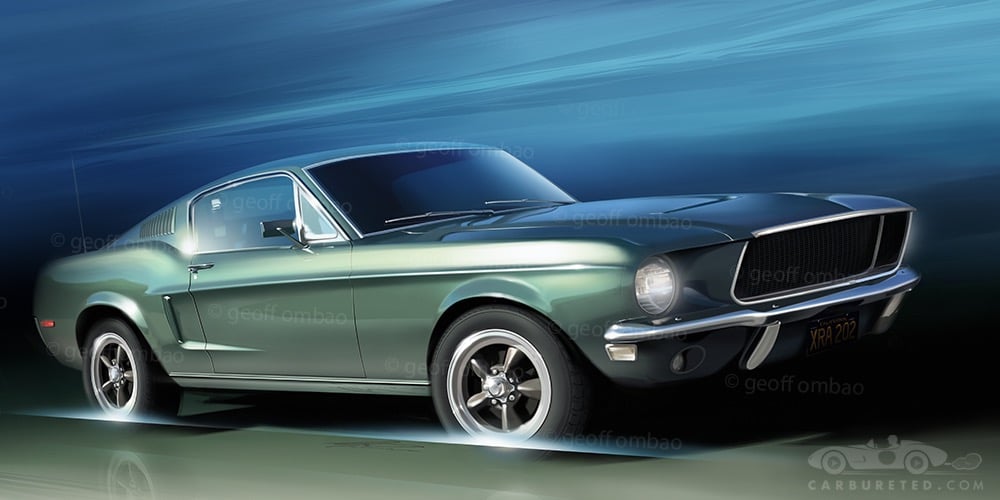
BULLETT MUSTANG © GEOFF OMBAO
GO: Getting into the school was tough, but staying in was tougher. The stories about long days, “all-nighters”, and biting critiques were true… and my past experiences weren’t as helpful as I had hoped. My Visual Communication skills were terrible. In an effort to improve, I sketched classic cars in my spare time. My thought was that this would allow
me to concentrate on my sketching/rendering skills; and by closely examining existing cars I would gain a better understanding of 3d forms. Gradually, creating classic car art became a passion.
I ended up taking interest in a lot of things at ArtCenter… product planning, viscomm, design, and even business. After graduating, ArtCenter gave me an extra semester (through their “Launch Lab” program) to explore an idea I had for a mobile EV charging system. With their help, I did a lot of research, put together a business plan, and I got some really good feedback from VC’s. The business was too capital-intensive for me to pursue at the time, so I put it on the back burner.
A couple of years after graduating, I had a massive heart attack. Having come close to death (actually, I crossed over the line for a few minutes), I put my career on hold to concentrate on my health. Since then, I’ve been teaching part-time (Human Factors & Design Psychology), creating art, and taking on projects from time-to-time.
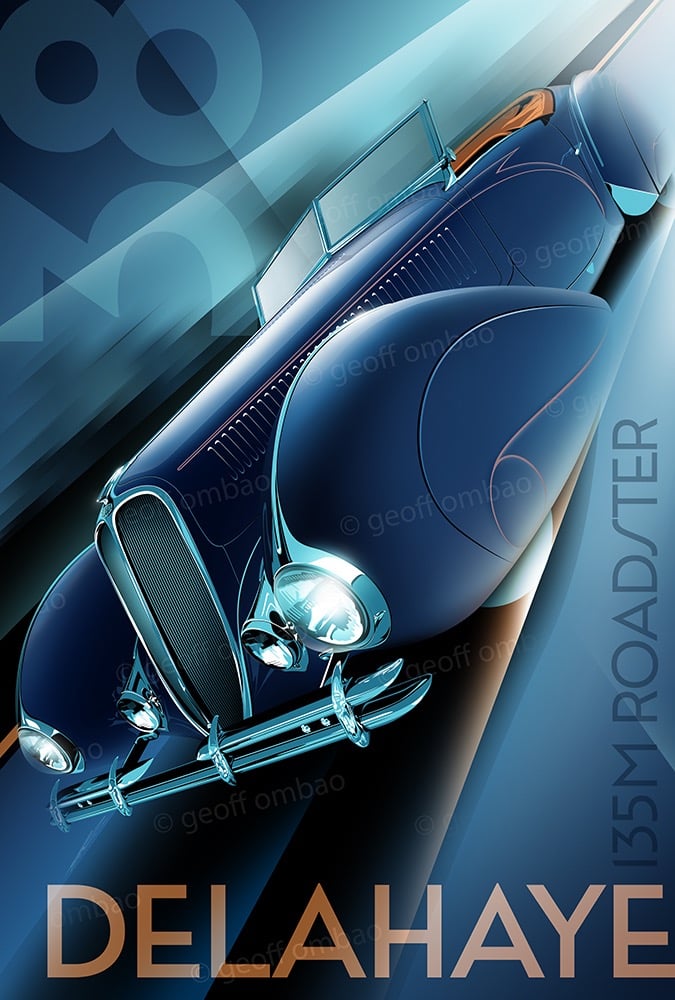
DELAHAYE 135M © GEOFF OMBAO
Torqart: Tell us about your passion for Art Deco styling and why we are still so attracted to 1930s shapes a century later. Is it nostalgia, or is there something hard-wired in our brains about those specific proportions?
GO: I have a great interest in 20th century art, but my more recent work tends to draw specifically from the Art Deco period. I like the graphic simplicity, formality, and romance in the era’s imagery. Being exposed to great Art Deco architecture also piqued my interest in this aesthetic (I once worked in Rockefeller Center, and used to walk past the Empire State Building, and other iconic buildings all the time). Though I draw inspiration from this movement, I’ve tried to evolve my style into something new… perhaps more “in-your-face”. This might stem from my graphic design roots, my love of Pop Art, and minimalism in general. I also think that working digitally allows me to do things that were difficult, expensive, or impossible to do back in the Deco era. I don’t think that I’m locked into this style… I’m always studying new aesthetic directions.
Interesting that you mentioned proportions. The proportions of the cars of this era differ dramatically from their modern counterparts. Their hoods were much longer (because of the engines of the time), and they had more pronounced dash-to-axle ratios. Perhaps we are drawn to these cars because their scale/proportions are so imposing, powerful, and seldom seen.
While studying merchandising, I learned about “Laver’s Law”, which postulated that attitudes towards fashion trends were cyclical, and predictable. By Laver’s timeline, Art Deco would today be considered “romantic”. I believe that Art Deco has always had (and will always have) strong appeal, perhaps its heightened popularity is, in part, a function of time.
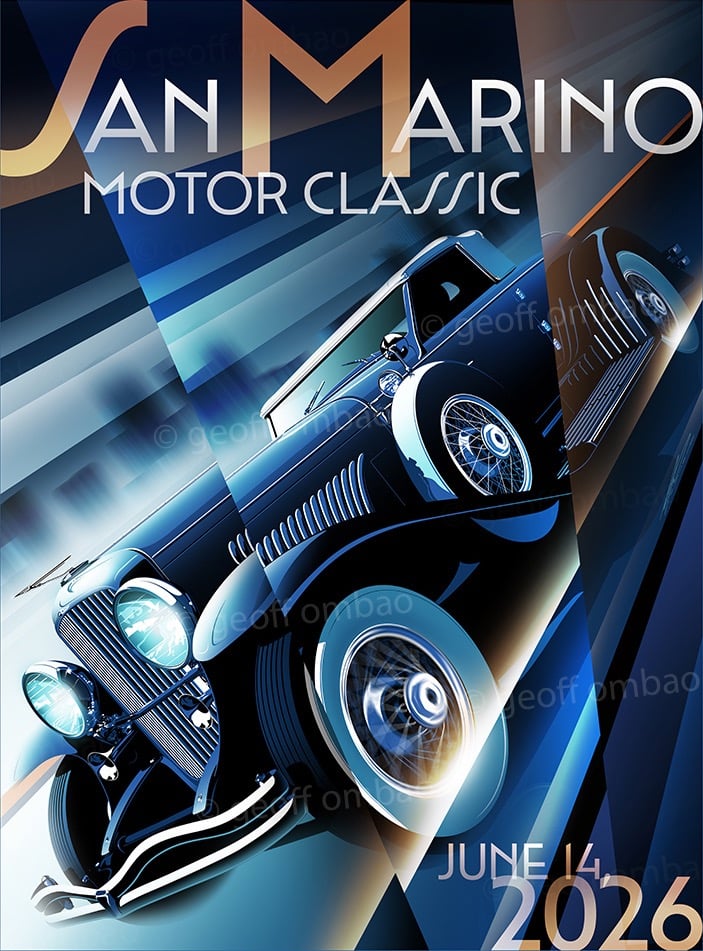
DUESENBERG © GEOFF OMBAO
Torqart: Your digital work often feels like it exists in a cinematic, noir-inspired world. How much of your process is about the car itself versus building the atmosphere that surrounds it?
GO: Thanks… I like the way you articulated that! When I started doing this, my work was pretty much all about the car. But over time, I realized that it would be more interesting for the viewer (and for me) to convey a mood, feeling, or to imply a story… so the environment slowly gained more importance. Lately, I’ve been going further by fragmenting my images to make the piece even less about the car, and more about the composition.
The deep dark blues that I’ve been using lately imply mystery (or perhaps something sinister). I usually compose my images with the car seemingly entering, or exiting the frame to imply that there’s a whole world that exists outside of the image, and that we are peering into it through a window. I present cars in a graphic, minimalist style to create a bold, arresting image. But more importantly, I believe that people want to exercise their imaginations… so by only providing enough of the car to make it recognizable, the viewer is forced to “fill in the blanks” with his/her imagination.
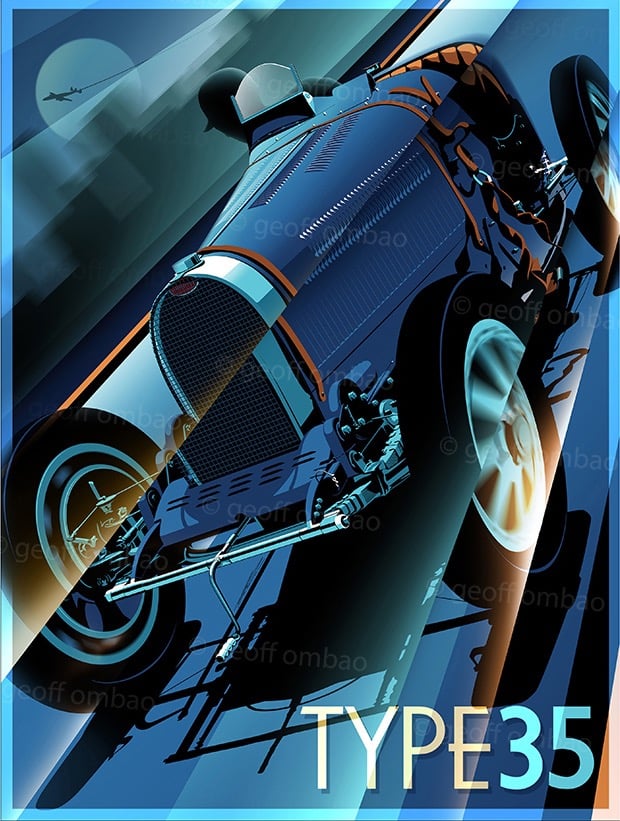
BUGATTI TYPE 35 © GEOFF OMBAO
Torqart: Could you walk us through your creative process - from your initial inspiration through to the finished piece, including some of your key techniques and the tools you use?
GO: Working from my own reference photos, I primarily use Adobe Illustrator and Photoshop. I start in Illustrator by blocking in the car’s large surfaces, and small details (headlights, wheels) using a very limited color palette. I include some of the environment, but I’m not very concerned with the overall composition just yet. Once things are blocked in, I take the image into Photoshop – where it’s much easier to add gradations, color nuances, and various effects. I also think Photoshop is a more gratifying environment in which to experiment (perhaps because its tools are more
similar to analog painting tools). I end up spending countless hours in Photoshop iterating color variations, lighting, composition, etc. It’s here where the image takes on its “mood”. Often, I’ll revisit a piece after days or weeks and continue to iterate. That’s the nice thing about working digitally… the paint never dries!
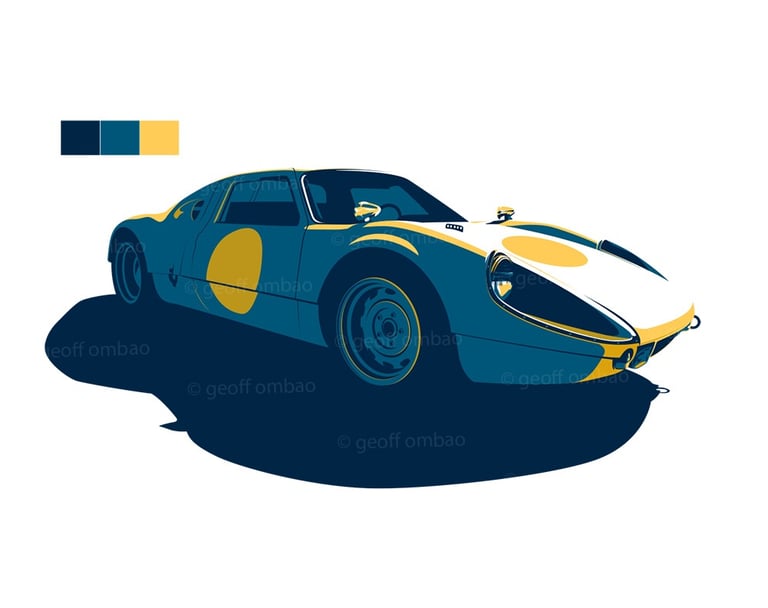
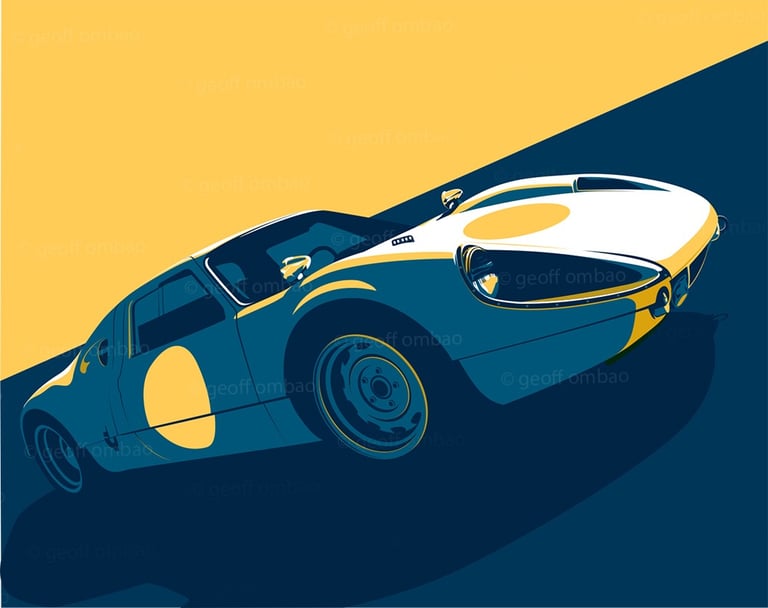
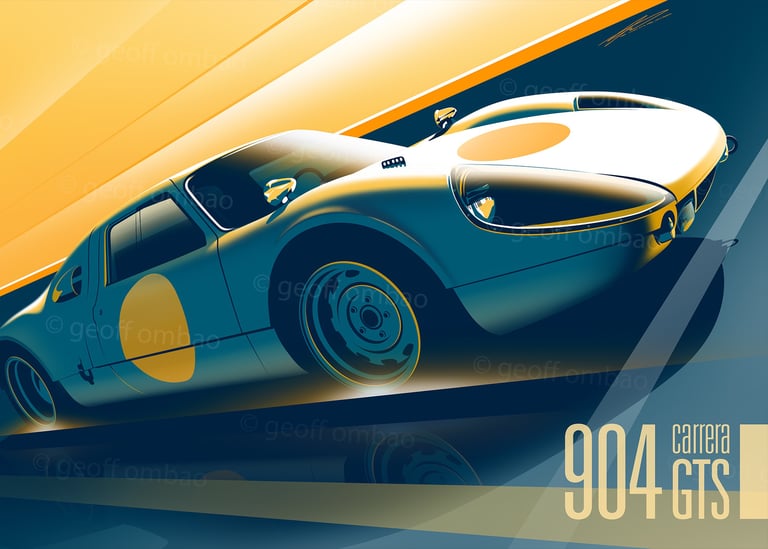
PORSCHE 904 GTS CARRERA © GEOFF OMBAO
Torqart: Can you tell us about one of your favourite peices and what makes it special?
GO: As I had mentioned earlier, I’ve been moving towards making my images less about the car, and more about a mood, environment, or about the composition itself. I think “French Curves” is one of my more successful examples of this idea. Here, the image isn’t about a specific car… rather, it’s about the voluptuous curved forms found in iconic Art Deco cars. So rather than featuring one car, I rendered two. Then, I zoomed in on the forms that I wanted to celebrate, and positioned them in a way that would encourage the eye to move between them. I also used type to add some playfulness and dimension to the composition.
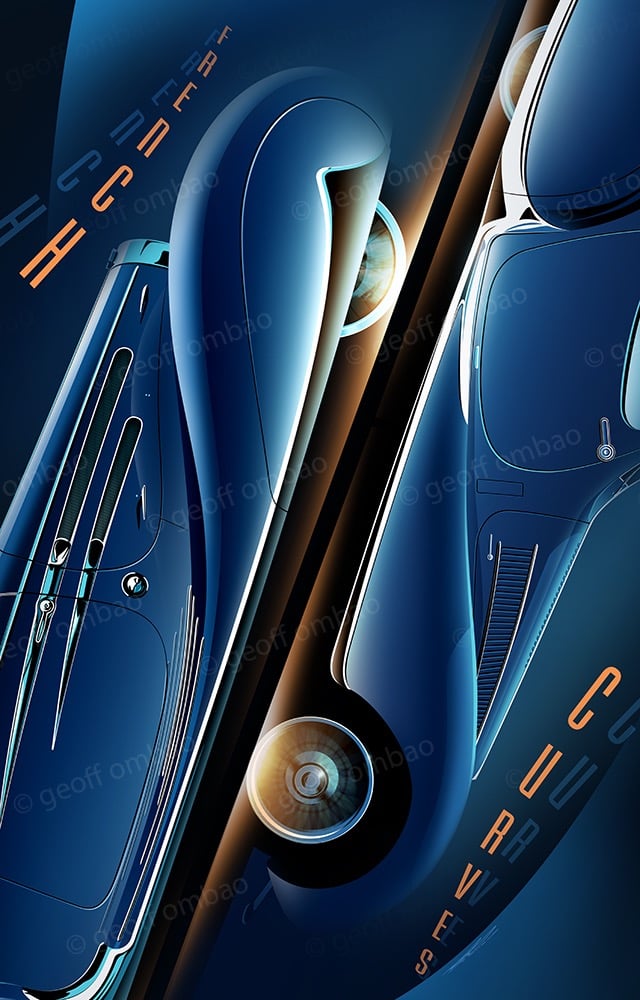
FRENCH CURVES © GEOFF OMBAO
Torqart: If you were tasked with designing a "Modern Art Deco" inspired concept car, which auto brand do you think would be most compatible with that aesthetic, and why – and is there any particular car from history that you would leverage for design language cues?
GO: Tough question(s)! I think it would be interesting to see Lucid play in the Art Deco space. They cater to an upscale market, and the Air is both elegant and quietly imposing… I think a coupe concept that explores how art deco aesthetics could interact with modern proportions/materials/technologies would be fantastic! The Talbot Lago Teardrop Coupe would be a great historic inspiration – its organic forms work well with Lucid’s design language.
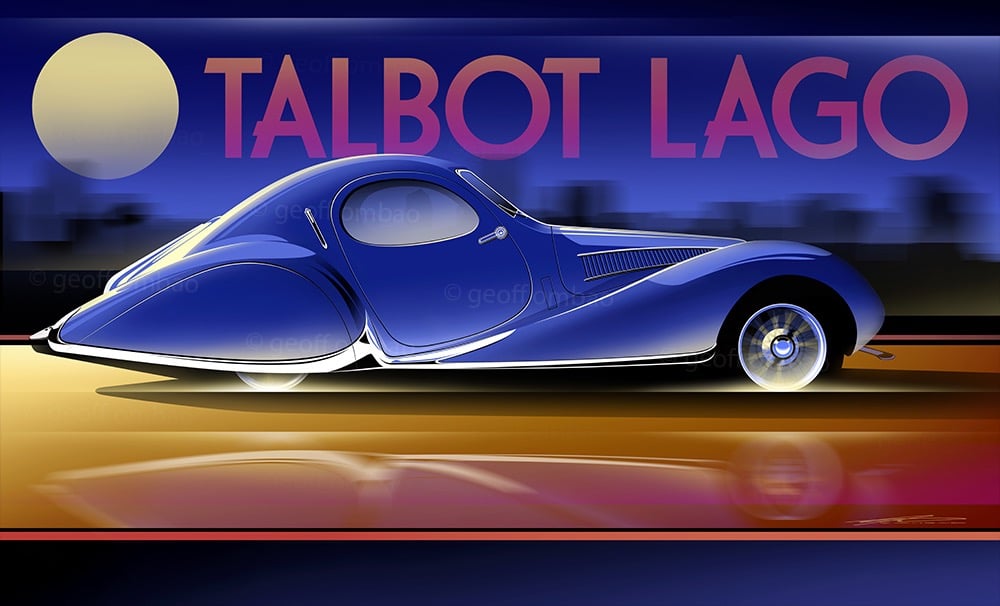

TALBOT LAGO © GEOFF OMBAO
Torqart: What has been the most rewarding aspect of your career as an automotive artist and as an instructor?
GO: This will sound a bit cliche, but as an artist, the work feels like its own reward. When I’m creating art (“art-ing”?), everything in the “real world” disappears and I get lost in creative exploration. Outside of that, I love when viewers “understand” what I am trying to convey when they look at my work… sometimes, I hear them use keywords that I was thinking (impactful, mysterious, or energetic, for example) when I was creating the piece. Or I hear them explain why a piece evokes a feeling, and their reasoning actually matches mine. This helps to validate that my style, technique, etc. was on target.
As an instructor, I take great pleasure in seeing students become passionate about user-centered design. This aspect of design can be undervalued by students, but when they realize its importance, and how it can elevate their work… that feels great.
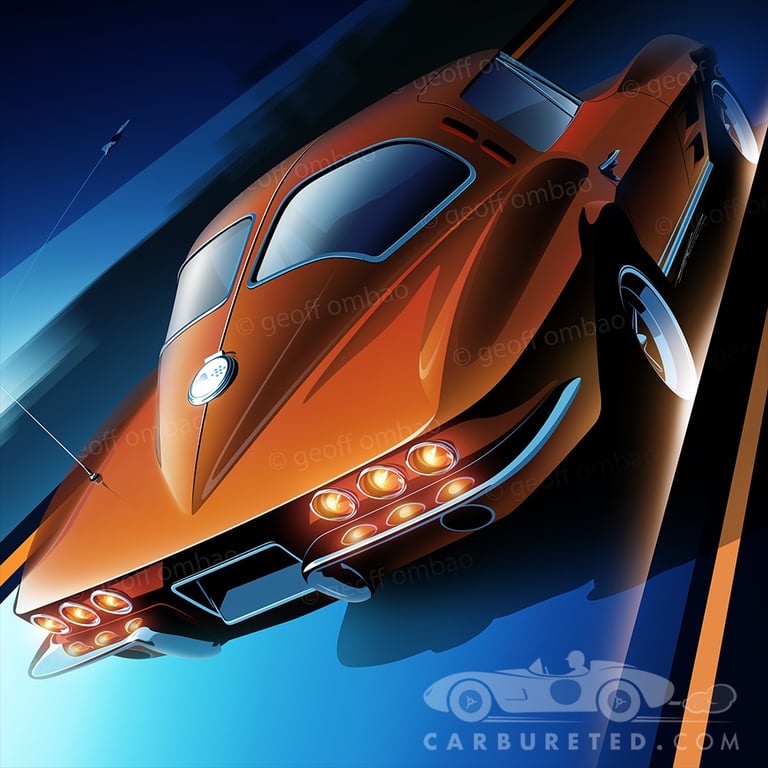
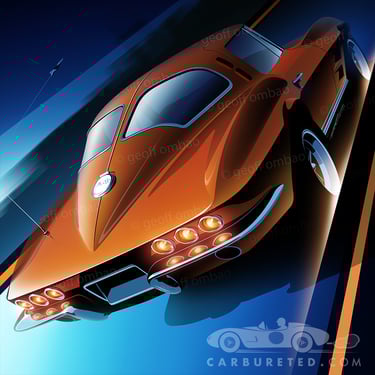
CORVETTE STINGRAY © GEOFF OMBAO
Torqart: Thank you for sharing your story and personal insights with us Geoff.
You can find more of Geoff Ombao’s work at...
Design: www.geoffombao.com
Art: www.carbureted.com
Instagram: @geoffyman

